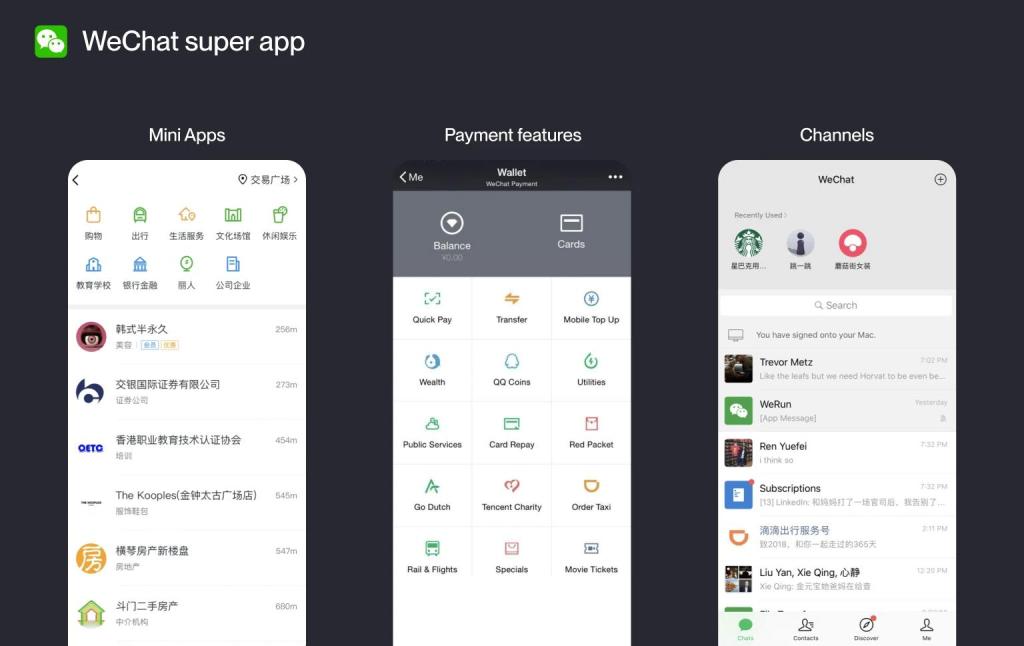
Image Source: Hey! Innovations, “Super App or Super Service”
Think about how many apps you use in a normal day. You might text someone, scroll through social media, order lunch, pay a bill, shop online, and look up a local business all through different apps
Now imagine doing almost all of that in one place.
That is what makes Weixin so interesting from a social media marketing perspective. Known internationally through its sister app WeChat, Weixin grew beyond messaging and created an ecosystem where users could communicate, shop, pay, discover content, and interact with businesses without constantly leaving the platform.
For marketers, the Weixin case shows that the best social media strategy isn’t always about getting people to look at more ads. It is about making the platform so useful that people naturally make it part of their everyday lives.
More Than a Social Media Platform
One reason Weixin became so successful was its understanding of its audience. Instead of simply copying other social networks, the platform continued adding features that fit users’ daily behaviors.
Today, Tencent describes Weixin as an integrated digital lifestyle platform with features such as Moments, Official Accounts, Weixin Pay, Mini Programs, Search, and Channels. Combined, Weixin and WeChat have more than 1.4 billion monthly active users.
For marketers, this creates something incredibly valuable: the ability to connect multiple parts of the customer journey.
A consumer might discover a brand through content, visit its Official Account, enter its Mini Program, receive an offer, make a purchase, and pay all within the same ecosystem. There are fewer interruptions and fewer opportunities for the customer to drop off.
That is very different from a social media advertisement that sends someone through several websites and apps before they can finally make a purchase.
Convenience Is Part of the Marketing Strategy
The biggest lesson I took from this case is that convenience itself can be a marketing tool.
We often think of social media marketing in terms of content, engagement, likes, shares, and followers. Those things matter, but Weixin demonstrates the importance of reducing friction throughout the customer journey.
Its Mini Programs are a great example. These are lightweight applications within Weixin that let users access products and services without downloading a separate app. According to Tencent, Weixin Mini Programs facilitated RMB 8 trillion in gross merchandise value in 2024.
As a consumer, I know I am much more likely to complete something when it takes two clicks instead of ten. Every additional login, download, or webpage gives me another opportunity to say, I’ll do it later which usually means I won’t.
Uber Shows How This Works in the Real World
A recent partnership with Uber shows that the strategy from the Weixin case is still relevant today.
In 2025, Uber launched a Weixin Mini Program that allows Chinese travelers to search for, book, and pay for Uber rides in international destinations directly through Weixin. Users do not have to download a separate Uber app, and the experience includes a Chinese-language interface and Weixin Pay.
This is a great example of a brand adapting to the customer’s existing digital habits instead of expecting the customer to adapt to the brand.
Rather than saying, “Download our app, create another account, and learn how to use it,” Uber essentially went where these consumers already were.
That is a powerful social media marketing lesson.
What Can Brands Learn From Weixin?
Obviously, not every company can build its own Weixin. However, brands can apply the same thinking to their own social media strategies.
Instead of asking only, “What should we post?”, marketers should also ask:
- How easy is it for customers to take the next step?
- Does our social content connect naturally to shopping or additional information?
- Can customers easily contact us with a question?
- Are we creating unnecessary steps between discovery and conversion?
This is where social media strategy connects directly with customer experience.
Research into WeChat marketing in China has also examined how organizations can use the platform to engage online audiences and support goals such as brand awareness and brand loyalty. This reinforces something we have discussed throughout social media marketing: engagement should contribute to a larger relationship between the consumer and the brand.
The Bigger Lesson: Know How Your Audience Lives
What stands out most to me about Weixin is that its success wasn’t based on one viral campaign or one clever feature. It came from understanding how people use their phones throughout the day and building around those behaviors.
That is a lesson marketers can apply on any platform.
Successful social media marketing should fit naturally into the customer’s life rather than interrupting it. Whether a brand is using Instagram, TikTok, LinkedIn, or Weixin, it should understand why its audience is on that platform, what they are trying to accomplish, and how the brand can make that experience easier or more valuable.
Weixin may be an extreme example of integration, but the principle behind its success is surprisingly simple: meet customers where they already are and make the next step as easy as possible.
And considering how quickly I close an app when something becomes inconvenient, I think that is a lesson more brands could use.


Leave a Reply